
The Best Investment You've Never Heard Of
by Last Mile Education Fund
An emergency award under $3,000 to a STEM student on the edge of dropping out returns nearly 50 times its value to society. Here's what the data shows.
Imagine a promising engineering student weeks from graduation forced to drop out because she can’t cover a $1,800 car repair.
Her car gets her to her internship. The internship keeps her loan deferment intact. Without it, the debt clock starts, and she walks away from a degree she’s spent four years earning.
This isn’t hypothetical. It’s happening right now, on campuses across the country.
Every year, thousands of capable, STEM students in the last mile to a degree leave college – not because they failed academically, but because of financial hurdles near the finish line.
Not an academic problem. A financial one. This is the problem Last Mile Education Fund exists to solve.
We provide fast, targeted cash awards, averaging less than $3,000, to students who are within reach of a degree but facing a sudden financial shock that could derail everything. A car repair. A rent gap. A lost laptop. The kinds of costs traditional financial aid was never designed to cover, but the ones that determine whether a student finishes or not.
At Last Mile, we treat these moments not as edge cases, but as predictable, solvable points of failure in the system.
And that leads to a critical question:
What is the return to society on removing the final barrier to graduation?
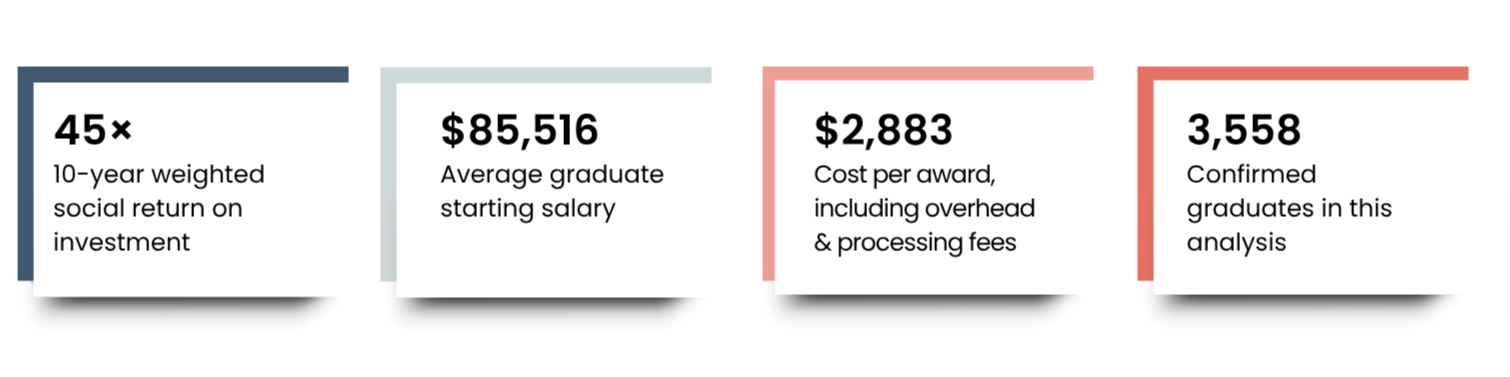
To answer it, we conducted a rigorous analysis grounded in real outcomes. Using salary data from 3,558 Last Mile graduates – matched to national labor market datasets – we measured the economic impact of helping students persist through to graduation.
The Result
A 45× social return on investment over 10 years – 6× return in private wage gains and government taxes in year one alone.
In other words, a modest, timely investment doesn’t just ensure a student graduates. It unlocks a decade of increased earnings, workforce participation, and economic mobility.
This is catalytic capital at its most efficient: small dollars, deployed at the right moment, producing outsized and compounding returns.
And importantly, these findings hold up under scrutiny. They are rooted in observed outcomes, conservative assumptions, and a clear causal pathway: when financially vulnerable students are stabilized at the point of greatest risk, completion becomes not just possible-but predictable.
* based on Census ACS
How We Measured The Return – And Why It Holds
The impact starts with a simple but often overlooked reality: in STEM fields, the difference between graduating and dropping out isn’t incremental-it’s a cliff.
Last Mile graduates earn an average starting salary of $85,516, compared to roughly $23,119 (based on Census ACS) for students who leave college without a degree – a $62,397 gap in year one alone. Over time, that gap compounds dramatically, exceeding $1.2M in cumulative earnings over a decade.
This is what makes last-mile intervention so powerful: a small, timely investment prevents a large, permanent economic loss.
To test the strength of this impact, we applied unusually conservative assumptions. We only attribute value where students confirmed the award was necessary to graduate, discount future earnings using private-market rates, and adjust for actual graduation outcomes. Even under these constraints, the results remain clear: A 45× social return over 10 years.
The model works because of two structural advantages: it targets students at the exact moment where outcomes diverge most sharply, and it does so with minimal capital. Compared to traditional workforce programs costing $12,000–$59,000 per participant, Last Mile’s <$3,000 intervention produces outsized returns by design.
The impact extends beyond individual earnings. Each graduate generates over $478,000 in public value over 10 years – shifting from net recipient of public support to net taxpayer, beginning in year one.
The conclusion is straightforward: When you remove the final financial barrier to graduation, completion becomes predictable – and the returns are not just high, but structurally inevitable.