
Blowing Past the Odds: Graduation Outcomes for Financially Vulnerable STEM Students
by Sarah A. Outland PhD
Leading the Last Mile data practice has always felt like a bit of a victory lap — the work happens, students are supported, and I get the luxury of crunching beautiful data that tells a truly golden story. This post — and what’s coming this spring from the Research Team at Last Mile — is no different.
In fall 2024, Last Mile prioritized the incredibly heavy lift of calculating our first pass at a graduation rate. You may have seen this referenced in previous reports as 74% — a truly staggering number when you consider that Last Mile students are some of the most financially vulnerable in this country, and when compared to overall college completion rates in the U.S.
In fall 2025, we revisited the data to double-check on students we previously had trouble locating. That work increased our graduation rate to 80%, which you may have seen in our 2025 Annual Impact Report (link). The nuance within this 80% is even more interesting — stay tuned for a more comprehensive Graduation Report this spring.
In this post, we’ll share a few highlights and explore how our data compares to national figures, drawn from a session our team recently presented at the Hawaii International Conference on Education.
As a reminder: Last Mile students are enrolled in both 2- and 4-year institutions and are not required to provide proof of performance or “merit,” as many traditional scholarship organizations require. If a student can show they are currently enrolled, within four semesters of graduation, and facing a financial gap they’re unable to fill, they generally qualify for a Last Mile award.
Graduation rate by institution level
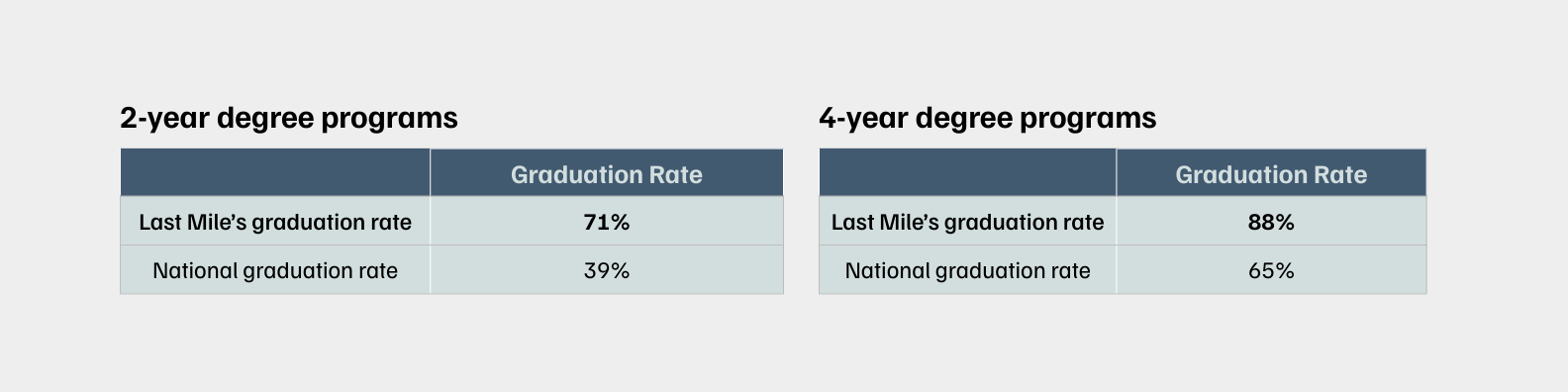
*All national-level data in the following tables comes from the graduation rates calculated by NCES found here.
There’s clear variation between degree types, largely due to historically low completion rates in 2-year programs and the fact that most dropouts in 4-year programs occur within the first two years of enrollment. However, these national graduation rates reflect all students. Last Mile students are more likely to be people of color, Pell eligible, first-generation, food insecure, and/or caring for dependents — populations that historically graduate at significantly lower rates than their peers nationwide. And yet, with a small investment from Last Mile, they are blowing national averages out of the water.
Graduation rate by gender
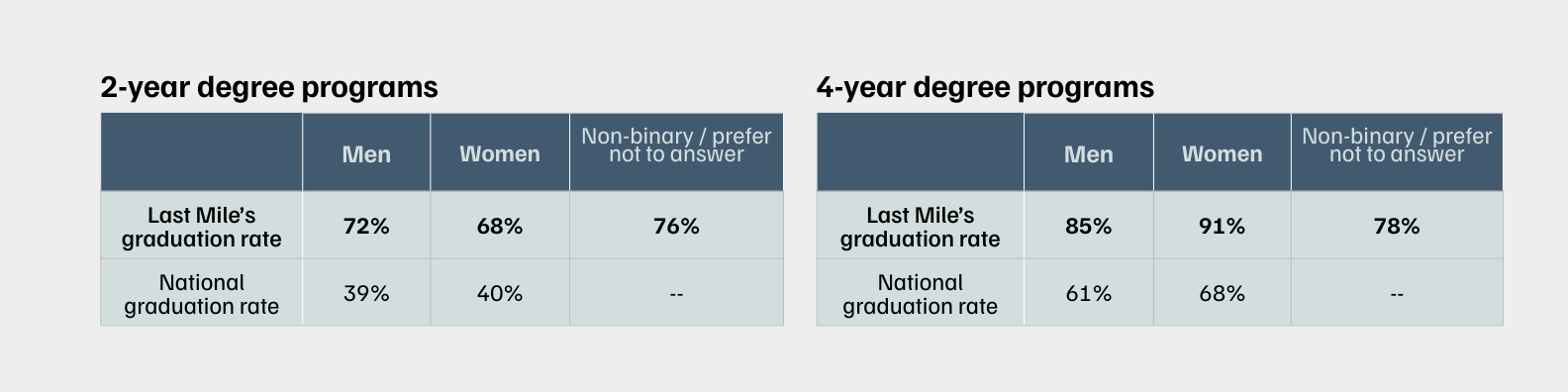
Across institution type and gender, we see higher graduation rates for Last Mile students. Within 2-year programs, men graduate at higher rates; within 4-year programs, women graduate at higher rates. Unfortunately, national data is not collected for students outside of the gender binary.
Graduation rate by race/ethnicity
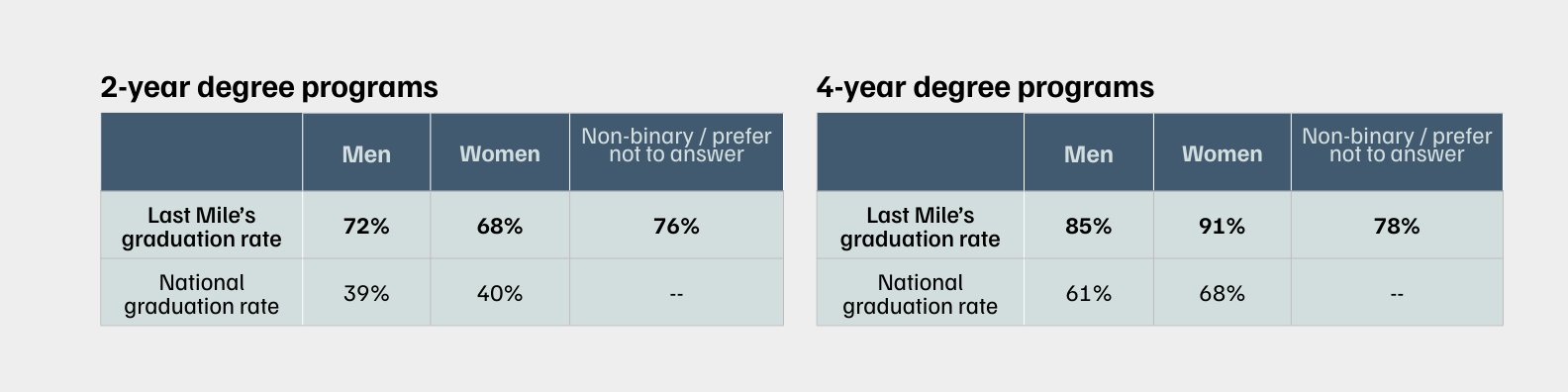
When we look at graduation rates by race/ethnicity for Last Mile students, we see particularly strong completion rates for our students who are Black. Not only is their rate higher than national averages — it is doubled\
Graduation rate by Pell eligibility
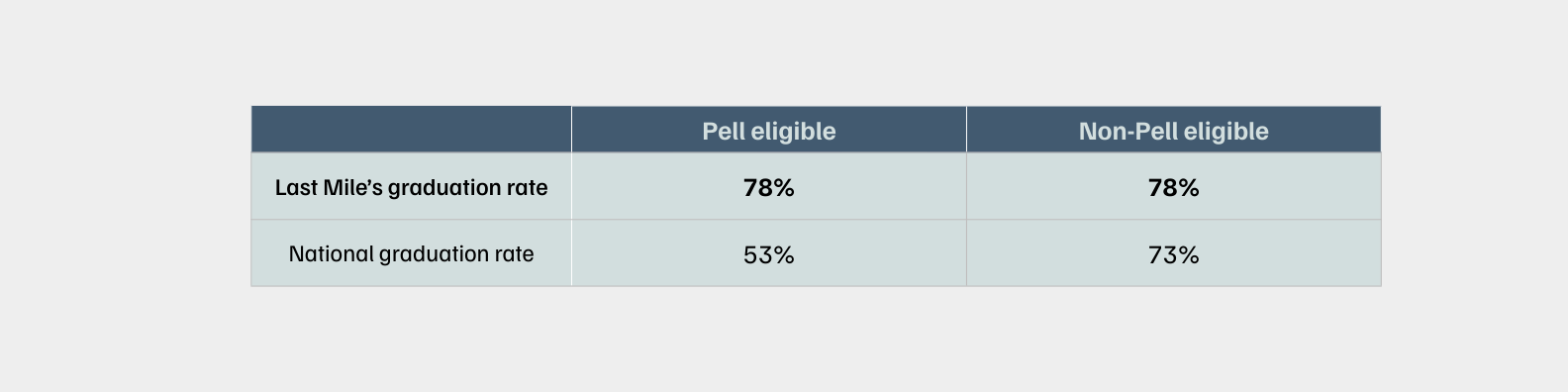
Perhaps most startling in this dataset are the graduation rates for our students who were Pell eligible. All students receiving Last Mile awards are facing financial vulnerability, and students who qualify for Pell Grants have adjusted gross incomes well below the poverty line calculated by the U.S. government. Last Mile students who are Pell eligible reach the same graduation rate as their non-Pell peers — an outcome rarely seen in outcomes data, especially alongside an overall high graduation rate.
What this data tells us - and what we already knew - is that this work is working. Low-dollar (under $3,000 on average), low-barrier (no GPA requirements) investments rooted in persistence rather than performance can make all the difference in getting a student to the finish line.
We’re just getting started with this data. Stay tuned for our graduation and employment report this spring, where we’ll dive deeper and situate these findings within the broader education landscape. We’ll explore questions like the role of grant size in educational outcomes, what variables might explain some of the patterns in this post, and more tailored national comparisons.